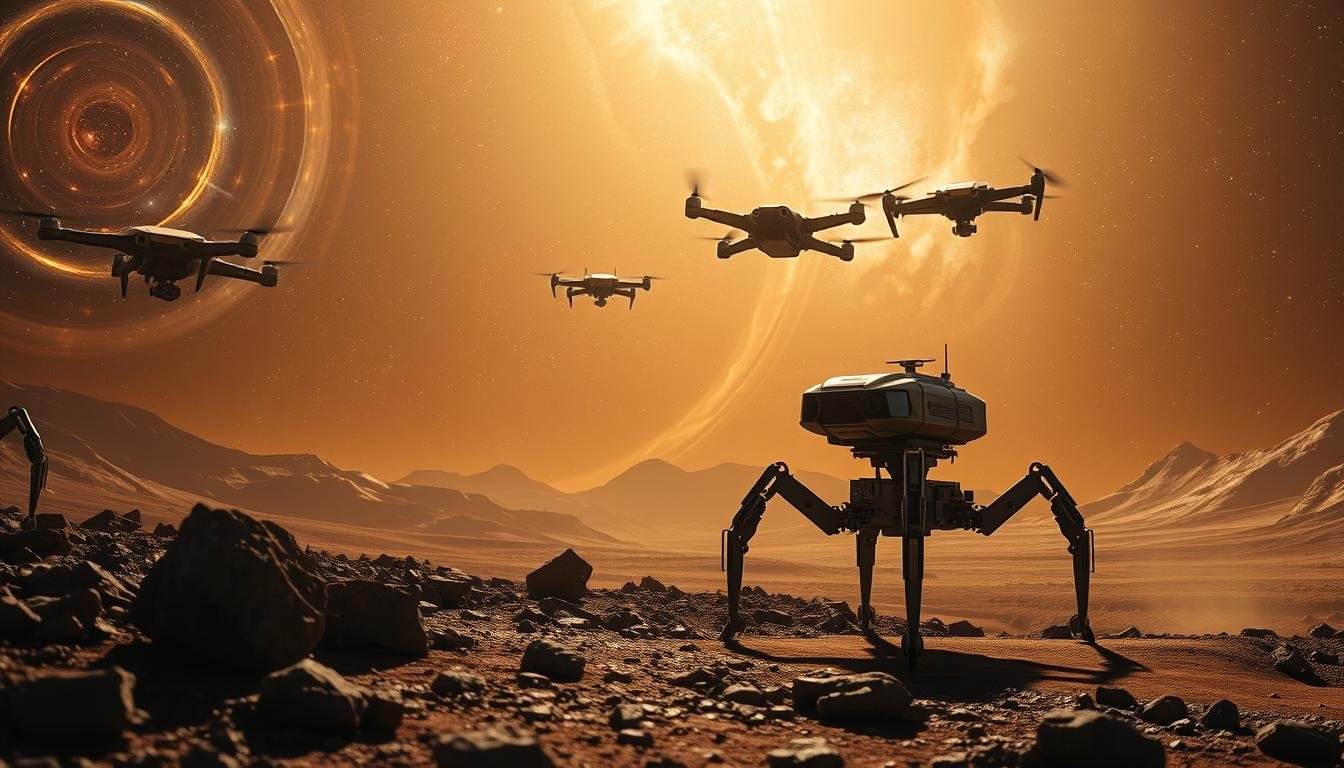
NASA leads in space robotics, using autonomous systems to explore space. Robotics play a huge role in understanding the universe.
Autonomous systems help gather important data and conduct experiments in tough places. As we move forward in space exploration, space robotics will become even more crucial.
Key Takeaways
- The importance of space robotics in advancing our understanding of space.
- NASA’s role in developing autonomous systems for space exploration.
- The potential for future space exploration to be shaped by robotics.
- The benefits of using autonomous systems in harsh environments.
- The growing significance of space robotics in the future.
The Evolution of Space Robotics
Space robotics has seen huge growth since the start of space exploration. Robotic systems have been key in learning about space and other planets.
Early Robotic Missions
The first steps in space robotics were early missions to the Moon and planets. These missions set the stage for future progress.
Lunar Rovers and Venera Probes
Lunar rovers from the Apollo missions and Venera probes on Venus were early pioneers. They gave us our first looks at these planets’ surfaces.
Viking and Early Mars Exploration
The Viking missions to Mars in the 1970s were a big deal in Mars exploration. They included landers that looked for life on Mars.
Milestones in Space Robotics Development
The creation of autonomous systems was a major breakthrough in space robotics. These robots can do complex tasks on their own, making missions more efficient and longer.
Transition from Teleoperated to Autonomous Systems
The move from controlled to autonomous systems changed space robotics. Now, robots can handle surprises and keep going without us, a big leap in space robotics evolution.
Current State of Robotics in Space Exploration
Space robotics have changed how we explore space. They help us understand the universe, from Mars to the International Space Station.
Mars Rovers and Their Capabilities
Mars rovers lead in space exploration. They give us insights into Mars. The Perseverance and Curiosity rovers are examples. They have tools to study Martian geology and search for life.
Perseverance and Curiosity Technologies
The Perseverance rover has many tools, like PIXL and SHERLOC. Curiosity has been in Gale Crater since 2012. It has taught us a lot about Mars.
Ingenuity Helicopter as a Robotic Scout
The Ingenuity Helicopter is with the Perseverance rover. It shows rotorcraft can explore Mars. Ingenuity has flown many times, helping with aerial views.
International Space Station Robotics
The International Space Station (ISS) uses robots for its work. Canadarm2 and Dextre are key. They help with tasks and maintenance.
Canadarm2 and Dextre
Canadarm2 moves around the ISS. It helps with equipment and astronauts. Dextre is a robotic hand for delicate tasks. It boosts the ISS’s abilities.
Astrobee Free-Flying Robots
The Astrobee robots fly inside the ISS. They help with tasks like inventory and monitoring. They show progress in space robotics.
Satellite Servicing Robots
Satellite servicing robots aim to make space operations more efficient. They can refuel, repair, and reconfigure satellites. This reduces the need for expensive replacements.
Autonomous Systems and AI Integration
Space exploration is changing thanks to autonomous systems and AI. These changes come from new machine learning, self-checking systems, and smart decision-making.
Machine Learning Applications in Space
Machine learning is key in space missions for better autonomy and decision-making. For example, NASA’s Mars rovers use it to move and find important targets.
Self-Diagnosing and Self-Repairing Systems
Spacecraft can now check and fix themselves, which is vital for long missions. Self-checking systems find problems and fix them on their own, keeping the mission going.
Decision-Making Algorithms for Remote Operations
Spacecraft need algorithms to make decisions on their own. These algorithms must deal with delays and make science choices without human help.
Handling Communication Delays
Communication with spacecraft can be slow, especially for far-off planets. They must make decisions without immediate human help, using set algorithms and current data.
Autonomous Science Decision Making
Spacecraft can now change their plans based on what they see and new conditions. This is key for getting the most science from a mission.
| Feature | Benefit | Application |
|---|---|---|
| Machine Learning | Improved Autonomy | NASA’s Mars Rovers |
| Self-Diagnosing Systems | Enhanced Reliability | Long-Duration Space Missions |
| Decision-Making Algorithms | Independent Operation | Remote Spacecraft Operations |
Robotics in Future Space Exploration: Key Technologies
The future of space exploration depends a lot on robotics. It makes missions more complex and longer-lasting.
Advanced Mobility Systems
Advanced mobility systems are key for exploring different planets. They help robots move over tough terrains. This includes the rocky Mars and icy moons of Jupiter.
Legged Robots for Extreme Terrain
Legged robots are made for extreme terrains. They can walk, jump, or climb. This makes them very versatile in tough places.
Aerial-Ground Hybrid Systems
Aerial-ground hybrid systems offer the best of both worlds. They can fly and land, exploring and sampling fully.
Next-Generation Sensors and Perception
Next-generation sensors are crucial for space robots. They help robots understand their surroundings better. This includes detecting obstacles and making smart decisions.
Energy Solutions for Long-Duration Missions
Energy solutions are vital for long missions in space. Since resupply is not possible, new energy storage and generation tech are being developed.
Nuclear Power for Deep Space Robotics
Nuclear power, like RTGs, is a reliable energy source for deep space. It lasts a long time, making it perfect for long missions.
Advanced Solar and Battery Technologies
Improvements in solar panels and batteries are also important. They offer better efficiency and longer life. This is key for missions that use solar power.
| Technology | Description | Benefits |
|---|---|---|
| Legged Robots | Robots designed to walk or climb on planetary surfaces. | Enhanced mobility in challenging terrains. |
| Aerial-Ground Hybrid Systems | Systems that combine aerial and ground capabilities. | Comprehensive exploration and sampling. |
| Nuclear Power | Energy generation using nuclear reactions. | Reliable, long-lasting energy for deep space. |
Robotic Exploration of Extreme Environments
Robots are being sent to explore the most extreme places in our solar system. They will visit icy moons, the tough surface of Venus, and the air of gas giants.
Subsurface Exploration of Icy Moons
The inside of icy moons like Europa and Enceladus is very interesting. Scientists think they might have liquid water and life. To explore these places, we need special robots.
Europa Clipper and Ice-Penetrating Robots
The Europa Clipper mission is a big effort to explore Europa’s inside. It has special radar to look at the ocean and ice.
Robots that can go through ice are being made. They might find out more about these moons and if they can support life.
Enceladus and Titan Exploration Concepts
Robots are planned for Enceladus to study its ocean through geysers. For Titan, robots that can move in its lakes and seas are being thought of.
Venus and High-Temperature Robotics
Venus is very hard to explore because of its extreme heat. Robots that can handle high temperatures are being made.
These robots will have special materials and electronics. They can work on Venus’s surface for a long time.
Gas Giant Atmospheric Probes
Robotic probes are needed to explore the air of gas giants like Jupiter and Saturn. These probes must handle extreme pressure and heat.
They will give us important information about these atmospheres. This will help us understand gas giants better.
Swarm Robotics and Distributed Systems
In space exploration, swarm robotics and distributed systems are becoming very important. They let many robots work together. This makes space missions more efficient and reliable.
Multi-Robot Coordination Strategies
For swarm robotics to succeed in space, multi-robot coordination is key. Decentralized control and adaptive algorithms help robots change their actions. They do this based on their surroundings and the mission’s needs.
Small Satellite Constellations
Small satellite constellations show how distributed systems work in space. They offer global coverage and real-time data. This boosts Earth observation and communication.
Collaborative Mapping and Exploration
Swarm robotics makes collaborative mapping and exploration possible. By dividing tasks among robots, missions can cover more ground. They can also map areas in detail.
Distributed Sensing Networks
Distributed sensing networks are vital for swarm robotics. They gather data from many places. This helps understand the environment better and makes decisions easier.
Redundancy and Fault Tolerance
Having redundancy and fault tolerance is essential in distributed systems. With many robots doing the same thing, the system keeps working even if some fail. This makes missions more reliable.
Human-Robot Collaboration in Space
Human-robot collaboration is key for future space exploration. As missions grow more complex, humans and robots must work together for success.
Astronaut Assistants and Companions
Robots that help and keep astronauts company are being researched. These robots aim to make space travel safer and more efficient.
NASA’s Robonaut and CIMON
NASA leads in creating robotic helpers for space. Robonaut can do tasks that need human-like skills. CIMON, an AI robot, helps astronauts with tasks and offers support.
The next robots will be even smarter, thanks to AI and robotics. They will be able to do many tasks, from fixing things to doing science.
Telepresence and Remote Operation
Telepresence lets humans control robots from afar. This is key for missions where people can’t be there in person.
Shared Autonomy Frameworks
Shared autonomy lets humans and robots work together smoothly. Robots can do things on their own but still get help from humans.
Precursor Missions for Human Exploration
Robots will scout out places for humans to explore. They will set up bases and do science before humans arrive.
Habitat Construction and Preparation
Robots will help build homes for humans in space. They will prepare sites, build structures, and set up life support systems.
| Robot | Function | Space Agency |
|---|---|---|
| Robonaut | Astronaut Assistant | NASA |
| CIMON | Interactive Companion | NASA/DLR |
| Future Humanoid Systems | Multi-purpose Assistance | Various |
Sample Return and In-Situ Resource Utilization
Sample return missions and in-situ resource utilization (ISRU) are key for space exploration. They help collect samples from other planets and use space resources. This makes us less dependent on Earth supplies.
Robotic Sample Collection and Processing
Robotic systems are vital for collecting and processing samples. They can work in tough environments. They can be controlled from Earth or work on their own.
Mars Sample Return Mission
The Mars Sample Return Mission is a big deal. It aims to bring Martian samples back to Earth. This will help us learn more about Mars’ geology and if it had life.
Asteroid and Lunar Sample Collection
Missions to collect samples from asteroids and the Moon are also important. They give us insights into our solar system’s history. Robots with arms and sampling tools are being made for these missions.
In-Situ Resource Utilization (ISRU) Systems
ISRU uses space resources for mission needs, like fuel and oxygen. It helps cut down on Earth resupply missions.
3D Printing and Manufacturing in Space
3D printing and manufacturing in space are big parts of ISRU. They let us make spare parts and tools when we need them.
Regolith-Based Construction
Regolith-based construction uses soil from the Moon or Mars to make building materials. This could help build habitats and infrastructure.
On-Demand Parts Production
On-demand parts production lets us make components as needed. This reduces our need for Earth-based supplies.
Challenges and Ethical Considerations
Robotics in space exploration come with big challenges and ethical questions. Robots face many obstacles as they explore space. These can affect their work and the success of their missions.
Radiation Hardening and Environmental Protection
Radiation hardening is a big challenge. It means making robots strong against space’s harsh radiation. This is key to keeping robots working well in space.
Communication Delays and Autonomous Operation
Another big challenge is communication delays between Earth and space. As robots go farther, talking to Earth gets harder. This makes robots need to work on their own more.
Planetary Protection Concerns
Planetary protection is a big ethical issue. It’s about stopping forward contamination (not spreading Earth germs to other planets) and exploring without harming the planet.
Forward Contamination Prevention
To stop forward contamination, spacecraft and robots must be super clean. This makes sure they don’t bring Earth germs to other planets.
Balancing Exploration and Preservation
Exploring space and keeping it natural is a tough balance. We must think carefully about how we explore to avoid harming the environment.
Artificial Intelligence Boundaries and Control
Artificial intelligence (AI) in space robotics brings up important questions. We need to make sure AI works as planned for the safety and success of space missions.
Conclusion
Robotics is key to the future of space exploration. Advances in autonomous systems, AI, and human-robot teamwork will change how we explore the universe.
Robotics can make space missions more efficient and effective. New mobility systems, sensors, and energy solutions will let robots explore further and gather more data.
But, there are challenges ahead. We need to deal with radiation, communication delays, and protecting planets. Yet, with more innovation and investment, we can overcome these hurdles and open new doors for space exploration.
The future of space robotics looks promising. Robotics will keep being a vital part of space exploration. It will drive discovery and expand our understanding of the universe.
FAQ
What role do robots play in space exploration?
Robots are key in space exploration. They help gather data and do experiments in tough places.
What are some examples of early robotic missions in space exploration?
Early missions like the Lunar Rovers, Venera probes, and Viking missions were important. They helped start the use of robots in space.
How have Mars rovers contributed to our understanding of the planet?
Mars rovers like Perseverance and Curiosity have helped us learn a lot about Mars. They’ve shown us its geology and if it could support life.
What is the significance of autonomous systems in space robotics?
Autonomous systems let robots do complex tasks on their own. This is vital in space because of long communication delays.
How are robots being used on the International Space Station?
Robots like Canadarm2, Dextre, and Astrobee help out on the ISS. They do maintenance, inspections, and run scientific experiments.
What are some of the challenges faced by space robotics?
Space robotics has to deal with radiation, long communication delays, and protecting planets. These challenges need to be solved for missions to succeed.
How will future space missions utilize robotics and AI?
Future missions will use more robotics and AI. They’ll do tasks like bringing back samples, using space resources, and working with humans.
What is in-situ resource utilization (ISRU), and how is it being used in space exploration?
ISRU uses space resources for mission goals. It makes fuel, oxygen, and building materials. This makes space missions more sustainable.
How do robots assist astronauts in space?
Robots like NASA’s Robonaut and CIMON help astronauts. They make space missions more efficient and safer.
What are some of the key technologies driving the future of space robotics?
Important technologies include better mobility, advanced sensors, energy solutions, and AI. These will help make space missions more complex and autonomous.