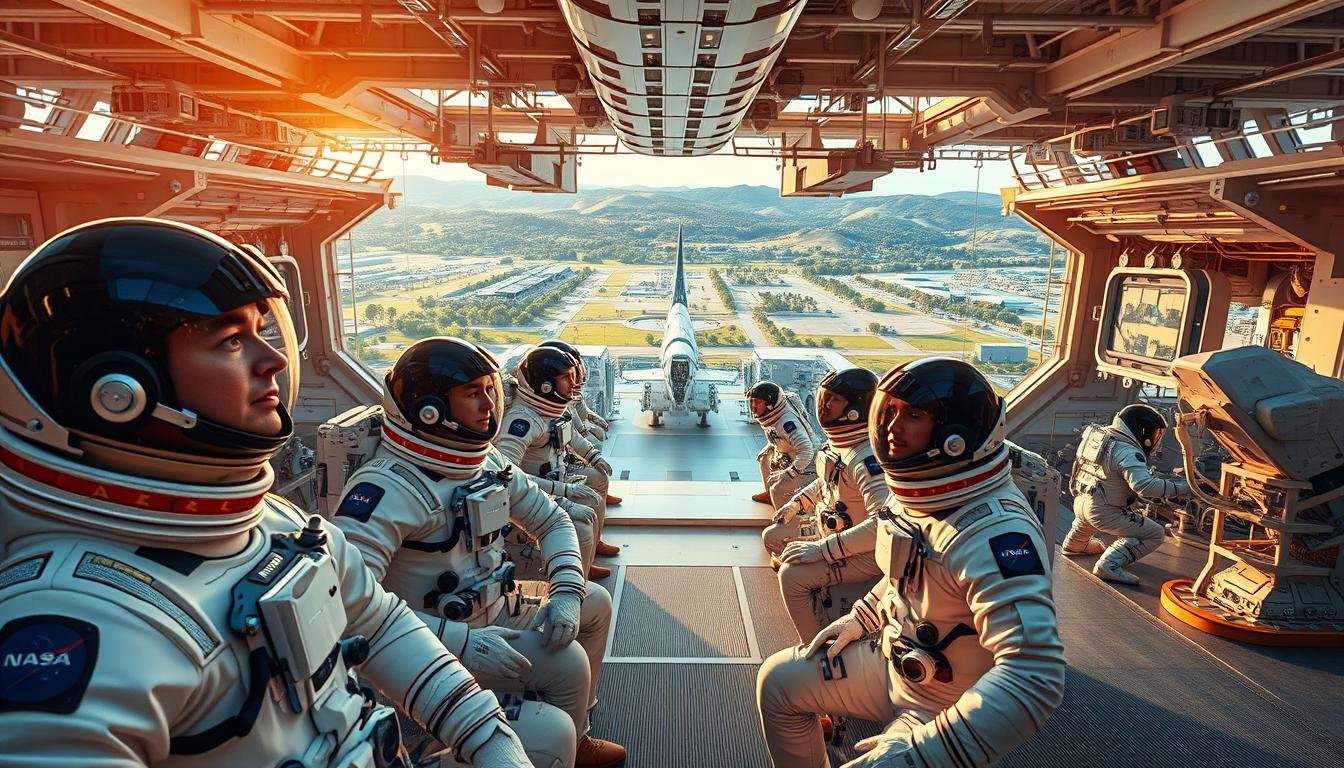
Getting astronauts ready for long space trips is a big job. It needs a full plan. This plan helps them get ready physically, mentally, and technically for long space flights.
Astronauts go through tough space mission preparation. They learn new skills and get used to the physical and mental challenges of space. This is key to their success.
Key Takeaways
- Astronaut training programs focus on physical conditioning, technical skills development, and mental preparation.
- Long-duration spaceflight requires specialized training to prepare astronauts for the unique challenges.
- Space mission preparation is critical to the success of extended space travel.
- Astronauts must be equipped to handle emergency situations and unexpected challenges.
- Technological innovations play a crucial role in enhancing astronaut training.
The Evolution of Astronaut Training Programs
The history of astronaut training is filled with innovation. It’s driven by the needs of more complex space missions. As NASA moved through different eras, astronaut training changed to meet new challenges.
From Mercury to Apollo: Early Training Methods
In the early days, the Mercury and Apollo programs focused on spaceflight’s physical and mental challenges. Training simulations were basic, using centrifuges and simple mock-ups. Astronauts also got physical conditioning for launch and re-entry.
Space Shuttle Era Advancements
The Space Shuttle era saw big steps in astronaut training. Sophisticated simulators were introduced, mimicking the shuttle and its payloads. Virtual reality was also used, making training more immersive. This era also emphasized team training for shuttle missions with large, international crews.
Physical Conditioning for Extended Space Travel
Physical conditioning is key for astronauts to handle the tough parts of space travel. As missions get longer, astronauts need a good fitness plan. This helps them stay fit for the journey.
Cardiovascular and Strength Training Regimens
Astronauts do tough cardiovascular and strength training for space missions. They work on heart health, build muscle, and boost endurance. This gets them ready for space.
Specialized Exercise Equipment for Space
Specialized exercise equipment is vital for staying fit in space. The ARED (Advanced Resistive Exercise Equipment) lets astronauts do exercises that help fight microgravity effects. It works many muscles at once.
Combating Muscle Atrophy and Bone Density Loss
Long space trips cause muscle atrophy and bone density loss in microgravity. Astronauts do special exercises to keep muscles and bones strong. This helps them stay healthy in space.
Balance and Coordination Exercises
Astronauts also do balance and coordination exercises. These help them stay aware of their space and move well in space and on Earth. It’s important for their safety and performance.
With different training methods, astronauts get ready for the tough parts of extended space travel. This ensures they stay healthy and perform well on their mission.
Psychological Preparation for Isolation
Astronauts face a big challenge when they go on long space trips. Their mental health is key to their success in space. Being alone for a long time can really affect their minds.
Confinement Studies and Simulations
Scientists do studies to learn how to handle isolation. They create space-like conditions on Earth. This helps them find ways to keep astronauts’ minds healthy during long missions.
Coping Strategies for Limited Social Contact
Astronauts learn how to handle being alone. They exercise regularly, do hobbies, and stay in touch with loved ones online. These steps help them stay mentally strong.
Mental Health Monitoring and Support Systems
Keeping an eye on astronauts’ mental health is crucial. They have regular check-ups and use new tech for quick mental checks. This shows how much they care about their astronauts’ well-being.
Real-time Psychological Assessment Tools
Tools for checking mental health in real-time are very important. They help spot problems early. This shows the effort to keep astronauts’ minds healthy during long space trips.
Technical Skills Development
Space missions are getting more complex. This makes technical skills for astronauts very important. They need to know how to use advanced spacecraft systems and have strong computer skills for their missions.
Spacecraft Systems Operation Training
Astronauts get a lot of training to learn about spacecraft systems. They learn about life support, propulsion, and communication equipment.
Simulator-Based Learning Approaches
Simulator training is key for learning spacecraft systems. It lets astronauts practice in a real-like setting. This prepares them for real mission challenges.
Computer and Software Proficiency
Astronauts also need to be good with computers and software. They learn to use operating system software, scientific apps, and tools for space tasks.
| Skill Area | Description | Training Method |
|---|---|---|
| Spacecraft Systems | Operation of life support, propulsion, and communication systems | Simulator-based training |
| Computer Proficiency | Operating system software, scientific applications, and specialized tools | Hands-on training and online courses |
Simulation Environments and Analog Missions
Simulation environments and analog missions are key in astronaut training. They let astronauts practice for space missions in a safe way. This helps them get ready for the challenges of space travel.
These environments mimic the real conditions of space missions. They can simulate microgravity or the isolation of long spaceflight. This prepares astronauts for what they will face.
Underwater Training Facilities
Places like NASA’s Neutral Buoyancy Laboratory (NBL) are used for underwater training. The NBL is a big pool that feels like space. It lets astronauts practice spacewalks safely.
Desert and Arctic Expeditions
Desert and arctic missions are like training for other planets. They teach astronauts how to survive in extreme conditions. This is crucial for future missions.
Closed Habitat Experiments
Closed habitat experiments, like NASA’s Human Exploration Research Analog (HERA), mimic long space missions. HERA is a sealed, three-story habitat. It studies how long spaceflight affects humans.
NASA’s Human Exploration Research Analog (HERA)
HERA is like a mock-up of a trip to an asteroid or Mars. Crews live and work there for weeks or months. They test their endurance and performance in simulated missions.
The following table summarizes the key features of different simulation environments and analog missions:
| Simulation Environment | Purpose | Key Features |
|---|---|---|
| Underwater Training Facilities | Practice spacewalks | Microgravity simulation, large pool |
| Desert and Arctic Expeditions | Survival in harsh environments | Extreme temperatures, remote locations |
| Closed Habitat Experiments | Simulate isolation and confinement | Hermetically sealed habitats, prolonged stays |
Training Astronauts for Long Missions: The Comprehensive Approach
Training astronauts for long space missions needs a detailed plan. This plan covers physical, mental, and technical skills. It’s key to make sure astronauts can face the challenges of long space travel.
Long missions require integrated training schedules. These schedules mix physical, mental, and technical training. This mix prepares astronauts for the mission’s demands.
Integrated Training Schedules
Integrated training schedules mimic the real conditions of long missions. They include physical, mental, and technical training. This gives a full picture of an astronaut’s readiness.
Simulation-based training lets astronauts practice for emergencies and working in space. It’s vital for their success in long missions.
Performance Evaluation Metrics
To check if astronauts are ready, performance evaluation metrics are used. These metrics look at both the numbers and the quality of their performance.
Quantitative and Qualitative Assessment Methods
Quantitative methods check physical skills like heart health and muscle strength. Qualitative methods look at mental health, teamwork, and adaptability. These methods help understand an astronaut’s readiness.
By using both types of assessments, space agencies can fully understand an astronaut’s readiness. They can also find areas for improvement.
Team Dynamics and Communication Skills
The success of long-duration space missions depends on astronauts working well together. They need strong team dynamics and communication skills to face challenges in space.
Multicultural Crew Preparation
Space agencies worldwide are working together on missions. This means crews are becoming more multicultural. It’s key to prepare astronauts for this diversity.
Training now includes cultural awareness and sensitivity. This ensures crew members can work well together, despite their backgrounds. NASA says, “astronauts must work as one, valuing each other’s unique skills and views.”
Conflict Resolution in Confined Spaces
Even well-trained teams can face conflicts in the tight spaces of spacecraft. Astronauts learn how to resolve disputes and keep a peaceful environment. They learn about group dynamics and how to solve problems in a positive way.
Case Studies from International Space Station Missions
The International Space Station (ISS) has shown us a lot about teamwork in space. A study on ISS missions found that teams with good conflict resolution and cultural training were more cohesive. Astronaut Scott Kelly said, “Working on the ISS taught me the importance of being adaptable and understanding the strengths and weaknesses of your crew members.”
These examples show how crucial it is to keep studying and training in team dynamics and communication for future missions.
Medical Training and Health Maintenance
Effective medical training is key for astronauts to stay healthy and handle emergencies in space. As space travel gets longer and farther, knowing how to diagnose and treat health issues is more important than ever.
Emergency Medical Procedures
Astronauts learn a lot about emergency care, like cardiopulmonary resuscitation (CPR) and handling injuries. This training is vital for dealing with serious problems in space.
Remote Treatment Protocols
Astronauts also learn about remote treatment, where they can talk to doctors on Earth in real-time. This helps them handle complex health issues better.
Self-Monitoring and Preventative Care
Apart from emergency training, astronauts learn about self-care and prevention. They do regular health checks, watch their vital signs, and live a healthy lifestyle to avoid getting sick.
With both emergency training and preventative care, astronauts are ready to keep themselves safe and healthy on long space trips.
Scientific Research Preparation
Preparing for scientific research is key for astronauts. It helps them do complex experiments in space.
Astronauts need to know a lot about scientific research. This includes how to design experiments, collect data, and analyze it. This knowledge is essential for long space missions where they will do many scientific experiments.
Experiment Design and Execution
Designing and doing experiments in space needs careful planning. Astronauts learn to design experiments for the space environment. They also learn to do these experiments with great precision.
Key aspects of experiment design include:
- Understanding the research question and objectives
- Selecting appropriate equipment and materials
- Considering the limitations and constraints of the space environment
Data Collection and Analysis Protocols
Collecting and analyzing data is crucial in space research. Astronauts learn how to collect and analyze data accurately.
The process involves:
- Collecting data using specialized equipment
- Storing and managing data for later analysis
- Analyzing data using statistical methods and software
Adapting Research Methods to Microgravity Conditions
One big challenge in space research is adapting to microgravity. Astronauts learn to change their research methods for the microgravity environment. This ensures their research is done well.
| Research Area | Experiment Type | Microgravity Adaptation |
|---|---|---|
| Biology | Cell Culture | Specialized containers to prevent cell drift |
| Physics | Fluid Dynamics | Use of surface tension to manage fluid behavior |
| Chemistry | Reaction Kinetics | Precise temperature control to manage reaction rates |
Emergency Response and Survival Training
Astronauts need to be ready for emergencies during their missions. Emergency response and survival training are key. They help astronauts deal with unexpected situations in space and after landing.
Crisis Management in Space
Crisis management is crucial for astronauts. They must handle emergencies like system failures or medical issues. Training helps them stay calm and make fast decisions.
Depressurization and Fire Response Drills
Astronauts practice for emergencies like depressurization and fires. These drills are vital. They ensure astronauts can protect themselves and their crew.
Post-Landing Survival Techniques
After their mission, astronauts must survive until rescue. Post-landing survival techniques include finding shelter and starting fires. They also learn to signal for help.
They train in different environments. This prepares them for various scenarios. It helps them survive and wait for rescue.
Future Innovations in Astronaut Training
New technologies like virtual reality, augmented reality, and artificial intelligence are changing astronaut training. These tools offer immersive, interactive, and personalized learning experiences. They help astronauts get ready for long space missions.
Virtual Reality and Augmented Reality Applications
Virtual reality (VR) and augmented reality (AR) are making astronaut training better. VR puts astronauts in virtual worlds, while AR adds digital info to real places. Both make learning fun and safe by letting astronauts practice complex tasks.
Artificial Intelligence Training Assistants
Artificial intelligence (AI) is now part of astronaut training. It helps create personalized training assistants. These AI systems check how well astronauts do, find what they need to work on, and adjust the training.
Personalized Training Programs Based on Performance Data
AI-driven training assistants make training fit each astronaut’s needs. They use performance data to predict challenges and plan how to solve them. This makes training more effective and efficient.
| Technology | Application in Astronaut Training | Benefits |
|---|---|---|
| Virtual Reality | Immersive simulations for spacewalks and emergency scenarios | Enhanced realism, improved retention |
| Augmented Reality | Overlaying digital information onto real-world training environments | Increased interactivity, better understanding of complex systems |
| Artificial Intelligence | Personalized training assistants, performance analysis | Tailored training programs, predictive analytics for challenge mitigation |
Conclusion
Training astronauts for long missions is a complex task. It needs a mix of physical training, technical skills, and mental preparation. As we explore space more, training astronauts will become even more crucial.
Today’s training programs are designed to get astronauts ready for long space trips. They learn to handle the physical and mental challenges of space travel. They also learn how to use complex spacecraft systems.
By focusing on astronaut training, space agencies can make sure their missions succeed. They can also keep their crew members safe.
Looking ahead, astronaut training will be key for deeper space travel. New training technologies and methods will help astronauts face long spaceflight challenges. This will open the door to even more exciting space exploration plans.
FAQ
What are the primary goals of astronaut training for long missions?
Astronauts train to be ready physically, mentally, and technically for long space trips. They learn to do their jobs well and handle emergencies.
How do astronauts maintain their physical health during long-duration space missions?
They stay fit with cardio and strength training. They also do special exercises to prevent muscle loss and bone thinning. They use the Treadmill with Vibration Isolation System (TVIS) and the Advanced Resistive Exercise Equipment (ARED).
What kind of psychological preparation do astronauts receive for long missions?
They prepare mentally with studies and simulations. They learn to cope with being alone and get mental health support. NASA’s Behavioral and Performance Sciences Group helps them.
How do astronauts develop the technical skills needed for long missions?
They learn about spacecraft systems and computer skills. They use simulators and onboard training to get ready.
What role do simulation environments and analog missions play in astronaut training?
Simulations and analog missions, like NASA’s HERA and underwater training, help them practice safely. They prepare for space challenges in a controlled setting.
How are astronauts trained to respond to emergencies during long missions?
They learn crisis management and how to handle depressurization and fires. They also learn survival skills after landing. This ensures they can handle emergencies well.
What is the importance of team dynamics and communication skills in astronaut training?
Good teamwork and communication are key for long missions. Astronauts must work well together, even in tough situations. Training for multicultural teams and conflict resolution is also important.
How do astronauts prepare for scientific research during long missions?
They train in designing and doing experiments, collecting data, and analyzing it. They learn to adapt research for space, ensuring they can do complex science experiments.
What future innovations are expected to shape astronaut training?
New tech like virtual reality, augmented reality, and artificial intelligence will change training. They will make training more effective and tailored to each astronaut’s needs.